
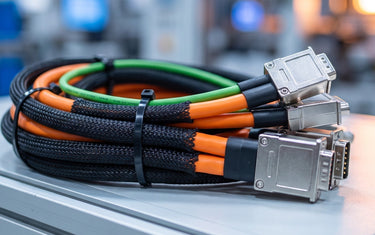
PRE-ASSEMBLED WIRING HARNESSES FOR WIND TURBINE AND SOLAR INVERTER PRODUCTION
A field-terminated connector fails, and the site visit to reach it costs more than the harness ever would. For wind turbine nacelle, tower and pitch applications, and for solar inverter or combiner box builds, the cable and the connector are engineered and verified as one part, not sourced separately and terminated by whoever is available that day. Agree the bill of materials and the test plan once, and that becomes one part number, one test result and one delivery schedule instead of three.
LAPP already supplies the ÖLFLEX® cable and the EPIC® connectors a wind turbine or solar inverter harness is built from. LAPP Harnessing Solutions takes that a step further: the assembly is designed, terminated and electrically tested before it reaches your line, rather than shipped as raw cable and connectors for someone else to join. This piece is for the production and sourcing engineers who own the build-versus-buy decision, and for anyone tracing a warranty claim back to a field-terminated connector.
That decision tends to surface at two points: during production engineering, when an OEM is deciding whether to terminate connectors on the line or source a ready-tested harness. The second point comes during second-source evaluation, after a warranty claim gets traced back to a field-terminated connector. It applies across wind turbine and nacelle component manufacturing, solar inverter and combiner box production, and EPC or system integrator teams assembling balance-of-system enclosures for wind and solar builds across Vietnam, Thailand, Indonesia and the Philippines.
Why build harnesses off the line instead of on it?
The cost case is not just the harness. A field-terminated fault that surfaces after installation, high in a tower or inside a sealed inverter enclosure, can mean a site visit, a crane or a production line stoppage to trace and rework, well beyond the cost of the harness itself. Testing the assembly before it ships moves that cost back to the factory, where it is cheaper to find and fix.
Field and line termination leaves connector quality dependent on the technician on shift that day, and variance from that step does not always show up immediately. It can surface months later, as an intermittent fault in a nacelle that is expensive to reach or a combiner box fault that is hard to trace back to its cause. A factory-terminated harness moves that variable off the line and into a controlled, tested process, where the same build steps repeat the same way on every unit.
Manual harness fabrication, stripping, crimping and testing each termination by hand, adds minutes per unit that a pre-tested assembly can reduce at volume. A turbine platform or an inverter family can also carry several distinct cable and connector combinations, which adds sourcing and build overhead before a single harness is even started, since each combination has to be tracked, stocked and terminated correctly on its own. Our guide to outsourcing cable harnessing for machine builders works through the same build-versus-buy math for a general industrial line.
The warranty case is the sharpest version of this. A field-terminated connector that fails under warranty leaves an ambiguous fault trace: component, termination or environment could each be the cause. Proving which one happened after the fact is difficult, particularly on equipment installed offshore or high in a tower where a technician cannot simply reopen the housing to check.
Raw cable, connectors and labour also carry separate lead times and separate suppliers. A pre-assembled, pre-tested harness can consolidate that under one agreed part number and one delivery schedule, with the fault trace narrowed before the unit ever ships.
What does a harness need for a wind turbine build versus a solar inverter build?
The two applications share a process, LAPP Harnessing Solutions, but not a design brief. A wind turbine harness has to account for the nacelle, tower and pitch duty cycle we covered in July's first piece: vibration, torsion and continuous motion, depending on where in the turbine the harness terminates. A solar inverter or combiner box harness answers a different set of questions: DC string inputs, high current density inside a compact enclosure, and outdoor thermal cycling on equipment that sits exposed at ground level or on a rooftop.
Because the design inputs differ, the harness has to be engineered against the application, not against a generic industrial duty cycle. That means confirming vibration and motion ratings for a turbine harness. For an inverter or combiner box harness, confirm current-carrying capacity and thermal rating instead, checking the datasheet for the specific EPIC® and ÖLFLEX® series involved rather than assuming one harness design covers both.
The connector housing follows the same split. A nacelle or tower harness generally calls for a vibration-rated EPIC® connector housing with a keyed, coded interface, so a technician working at height cannot mate the wrong pair under pressure. An inverter or combiner box harness is more often built around a compact, high-density housing suited to the enclosure it terminates into.
Both start from the same EPIC® and ÖLFLEX® ranges; the housing and cable series selected from within them is what changes.
Two things sit outside this piece, stated plainly. PV panel-level string connectors at the module are a different, already-covered topic. And any harness design work inside the turbine's or the inverter's own power electronics stays with the OEM's design team; LAPP's role is the cable, the connector and the tested assembly between them, not the electronics on either side of it.
How does LAPP test a harness before it reaches your production line?
Every harness is built and electrically tested against an agreed bill of materials and test plan before it ships, so the unit that reaches your line is the same unit that was verified in the factory, not a field-terminated approximation of it. That agreement is set once per harness design, which is what turns three separate purchases, cable, connector and labour, into one part number with one known test result.
The same engineers who specify the connector against a zone's duty cycle build the test plan for the harness assembled from it, so nothing about the finished part is guessed between the datasheet and the unit that ships. For a repowering programme or a new platform, that also means the harness design and its test plan can be locked once and reused across a production run, rather than re-decided on the line for every unit.
For the exact test parameters and ratings on any harness configuration, the LAPP APAC catalogue and the product specifications are the source of record, not a general claim in this article. This series sits under our broader renewable energy connectivity guide for solar, wind and storage, which covers the same component-level choices this piece builds on.
Talk to Our Engineers
If you are weighing build-versus-buy on wiring harnesses for a wind turbine platform, a solar inverter range or a combiner box design, our connectivity specialists can help you match the harness to the enclosure and the duty cycle. Tell us the application and the volume, and we will work out whether a pre-assembled harness or on-site termination is the better fit for your build.
Talk to our connectivity specialists through the LAPP SEA enquiry page and ask for the wind and renewable energy channel.


