

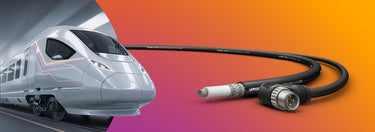
Our range of railway technology products complies with a wide range of international standards and safety requirements. We operate in over 80 countries, ensuring global availability and first-class service.

The high level of availability and smooth operation of railway vehicles depend largely on the railway cables and cables used. Whether they are needed for power supply, data transmission or control – reliable connectivity solutions enable smooth operation and safe transport.
Cables and wires must have specific properties to be suitable for use in railway vehicles. Compliance with statutory fire safety requirements is even a factor in the approval process. The key consideration here is to ensure the highest possible level of safety for passengers, staff and goods.
In the vehicle, railway cables, cables, conduit glands and connections are subjected to extreme stresses. In addition to mechanical stresses such as stone impact, torsion and severe vibrations, chemical substances – including oils, acids and cleaning agents – also affect the materials.
When used outdoors, there is also the additional factor of intense UV radiation. Furthermore, extreme climatic conditions during operation place high demands on the material properties of all components.
To withstand these influences, the solutions used must be designed for particularly wide temperature ranges. Railway cables, for example, are often designed to withstand temperatures ranging from –50 °C to +120 °C.
Fire safety, in particular, is treated with the utmost importance in railway vehicles and is subject to different regulations around the world. For example, EN 45545-2 applies in the European Union; in the USA, in addition to NFPA 130, standards relating to the toxicity of smoke gases, such as BSS 7239, are also applied; in some regions of the world, the British Standard BS 6853 is used, whilst in Russia, GOST is applied. The materials and components for railway vehicles are subject to clear specifications. Railway cables and connectivity solutions must therefore have the following essential properties:
- Halogen-free
- Flame-retardant
- Self-extinguishing
- Low flue gas
The products used do not contribute to the spread of fire and prevent additional injury and damage in the event of a fire.
When selecting and installing railway cables and cables, the relevant national or regional standards must be observed. Within the EU, these are EN 50355 and EN 50343.
These contain, for example, guidelines on selecting the correct cable types, current ratings and the sizing of cable cross-sections.

Reach your destination faster
Reach your destination faster
Production sites in Asia and Europe, complemented by a global logistics network
No minimum order quantities, customised cuts possible
Tailor-made solutions for mass-production requirements and complex large-scale projects

Certified on track
Certified on track
Own electron beam crosslinking system
IRIS / TS 22163 certification at the LAPP Korea LLC and LAPP India production sites
Cable types in accordance with EN 50306, EN 50264 and EN 50283, as well as other standards
High production quality and reliability

Running reliably for decades
Running reliably for decades
Over 60 years of development and manufacturing
Many years of experience in the rolling stock market
Complete connection solutions from a single source
Individual solutions for special requirements
Can't find the right product for your needs?
Together, we can develop individual solutions, customized for you. Our experts would be happy to guide you.
